.png)

A Revolutionary War Story: Those Spooner Boys
Updated: May 2
By Cynthia Doherty
During what genealogists call “A Sunday drive”, or some might call “going down the rabbit hole”, I came across the name of a Revolutionary War soldier named Wing Spooner.
What I eventually found was an entire family made up of patriots, fighting in the American War for Independence.
Let’s start with the Spooner Boys’ father Daniel Spooner (1694-1787). Daniel was the son of Experience Wing who in turn was the daughter of Daniel Wing, one of the three brothers who came to Massachusetts in the early 1630’s.
Daniel Wing
Experience Wing-----Samuel Spooner
Daniel Spooner ----Elizabeth Ruggles
Daniel Spooner has been described as:
“…an active thorough going reliable man, devoted to his family and friends…..
in all the trying times of the Revolutionary conflict, although beyond the
age of man, he took a most decided interest and gave his full influence on behalf
of his country.”
Daniel was a Deacon in the Church in Petersham, Massachusetts. He was a carpenter by trade. This meant he had to go where the work was. Often he was away during the week, coming home on Saturday night in anticipation of sharing the Sabbath with his family. He evidently believed strongly in “spare the rod, spoil the child.” A great grandson relates that when Daniel came home on the weekend, he would call the boys to him and whip them, “without inquiry”. His theory was they most likely had done something wrong. Why ask their mother? More expedient to get it over with quickly, I guess.
Daniel was in his eighties when war broke out. Too old to fight. But his boys took up arms.
Daniel’s sons, the Spooner Boys:
Daniel Wing -
Experience Wing-----Samuel Spooner
Daniel Spooner ----Elizabeth Ruggles
Paul
Daniel
Eliakim
Ruggles
Shearjashub
Phillip
Wing
Paul Spooner (1746-1789). The first military record I found for Paul was a two day “March to Orford Alarm.” He was listed as “surgeon”. Interestingly he was under the command of Lieutenant Daniel Spooner, his brother. I wonder how that worked out. The second record for Paul shows that he was guarding a prisoner. They were to march “from Winsor to Albany and from there to Barrington”.

The prisoner was a man named Zadok Wright. Mr. Wright had tried to remain neutral at the beginning of the War but eventually took the side of the Loyalists. He lived in Hartland, Vermont, as did Paul Spooner. They most likely knew each other. Mr. Wright fled to Canada, leaving his wife and children in his home in Hartland. He was captured when he went back over the border in an attempt to bring his family to Nova Scotia.
Zadock was in an Albany prison when he met Anne Lee, founder of the Shakers. She assured him that his life would be saved and all would be well. Zadock was imprisoned for three years. However, after the war, just as Mother Ann predicted, he was able to go back to his wife and family in Vermont and lead a good life as a devout believer in the Shaker ideology. Mr. Wright, before the war, was a well-respected man, holding many offices in the town. I want to believe that he and Paul Spooner, his former jailer, were able to let bygones be bygones and live together as good neighbors.
Paul died at the age of 44. He had practiced medicine and when he died he was a judge in the Vermont Supreme Court. He had previously served as lieutenant governor of the Territory of Vermont.
His obituary states “the honour and benefit accruing to the town by his dwelling among them has been largely experienced; the loss whereof may be long felt and regretted.” It goes on to say that, even though the funeral was held two days after his death, “500 to ten hundred” came to his funeral.
Daniel Spooner (1741-1828) I’ve found little about Daniel’s time as a soldier. We know he was a lieutenant and commanded a company of soldiers. In 1780 he represented Hartland, Vermont, in the General Assembly. He married Abigail Munroe and they raised 8 children, four boys and four girls, in Hartland. Abigail and Daniel lived long enough to celebrate their fiftieth wedding anniversary together.
Eliakim Spooner (1740-1820) Eliakim was a private in John Wheeler’s company of

Minute Men who marched to the Battle of Lexington April 19, 1775. “Minute Men” were specially trained and chosen for their youth and ability to be ready to deploy at a “minute’s notice.” We will see that more than one of the Spooner Boys were in this elite unit of the Massachusetts militia.
Eliakim married Bathsheba Warner in 1766, and they resided in Worcester, Mass., until 1780. Records show he was involved in the workings of the town, holding various public offices. He and his family moved to Vermont where Eliakim was an innkeeper in Woodstock. He continued to be involved in public life, representing his town in the State Legislature and as a member of the Executive Council of Vermont for seven years. Eliakim and Bathsheba had two sons, Eliakim and Alfred.

Alfred’s wife died in 1816 leaving him with nine children, ranging in age from two to fifteen. Records show that Alfred “went south” and left his children with their grandparents. I can only imagine how that must have changed the life of Eliakim, a septuagenarian at the time.
Ruggles Spooner (1737-1831) Ruggles served in the French and Indian War in 1757, when he was a young man. Eighteen years later, when he was closer to forty, he served with his brother Eliakim as a Minute Man in the Battle of Lexington April 19, 1775. He continued to serve as a volunteer under the command of Colonel Drury and later Colonel Cushing.
Ruggles appears to have been a complicated man.
“It is said that Ruggles Spooner was of a very stubborn and contentious
disposition; that he was constantly in trouble and never free from a law suit…”
There are two reasons I have found to agree with the above statement. The first is a cryptic sentence:
“He was involved, to some extent, in Shay’s Rebellion, but, for this offense,
he was not brought to trial.”
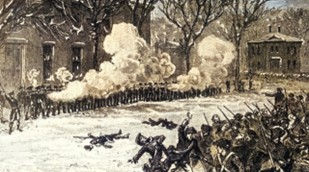
Shay’s Rebellion happened soon after the War for Independence (August 1786-February 1787). Economic conditions had deteriorated enormously. It was difficult to impossible to get goods from overseas. The new government was inflicting more and more taxes on its people to pay for the war they had just fought and the cost of forming a new republic. In some ways I imagine Daniel Shay and his followers felt they were fighting the same war over again.
I have been unable to find Ruggles Spooner in the list of men who were ordered to sign an oath of allegiance after the rebellion was put down. However, he lived in Petersham, Massachusetts, the site of the last stand of the rebellion and his difficult nature makes it seem plausible that the above reference to his participation is true.
Ruggles may have experienced, in the opposite manner, what his brother Paul did. Paul was the jailer for a man with whom, after the war, he would continue to be neighbors.
Ruggles participated in a rebellion against the nascent government and, when it was put down, would continue to live in the same town with neighbors who had had to endure the turmoil he caused.
Captain Park Holland, sent to put down Shays Rebellion, had this to say about it:
“ I would observe, there are many things to be considered before
we condemn the misled followers of Daniel Shays. Their leaders
were ignorant and many of them deceived. Our government was a
new untried ship, with many joints that needed oiling, to say the
least, with no chart of experience to guide us, nor map of the past, by
which to lay our course. We, who stood by the side of these men, in
many hard fought battles, with a powerful enemy and witnessed their
hardships and sufferings borne without a complaint, would much ra-
ther remember the good service they rendered their country, than
dwell upon what historians have set down as a black spot upon their
country's pages.”
There is yet another incident that goes to the truth of Ruggles’ belligerent nature. Ruggles Spooner was involved in a breach of promise suit with Sarah Peckham. Before jumping to any conclusions, it was not Sarah who brought suit against Ruggles. Ruggles Spooner sued Sarah Peckham for breach of promise in the amount of $5000 (worth about $140,000 today).
His suit claimed that he had proposed marriage and Ms. Peckham consented. He said he was ready at any time to marry her. By the time the suit went to court Ms. Peckham had married another.
Sarah Peckham’s attorney argued that women should be allowed to:
“shuffle, equivocate and coquet as much as they pleased in making the
particular bargain of matrimony.”
Ruggles Spooner lost his case, most likely because he had neglected to get a signed contract.
Ruggles married Mehitable Nye in 1793 when he would have been in his mid fifties and she, born 1758, in her mid thirties. I find no record of any children.
Ruggles’ old age was a difficult one. He evidently lost all his property, went blind and became disillusioned with the church. I imagine he was suffering from severe depression.
Could some of his “contrariness” have to do with what we now call PTSD? We will never know.
Shearjashub Spooner (1735-1785) Shearjashub married Sarah Whipple in 1760. Together they had ten children, nine of whom were born before Sherjashub was to fight in the War of Independence. Following in the footsteps of his brothers’ Daniel and Paul, he enlisted on August 21, 1777, and joined his brother Wing Spooner’s company. Again, I wonder how that worked out. They marched from Petersham to Bennington to reinforce the army under General Stark. It is about 180 miles round trip. He was reimbursed for nine days at twenty miles a day. I wonder if that included the expense of a new pair of boots.
Shearjashub Spooner was known for his intelligence, though he had little formal education. Unfortunately he made a bad investment in Continental paper at the end of the war and was forced to forfeit his property to pay his debts.
Shearjashub had built a home in Petersham, Massachusetts, in 1760, the year of his marriage. He called it “Bobolink Farm”. Bobolink refers to a bird common in that area. It was a large, rambling home, suitable for the large family he and his wife had over time. He apparently sold it in 1779 and moved to Heath, Massachusetts, a town that had recently been incorporated. I can only assume that he was forced to sell his home to pay his debts.
Like his father Daniel, Shearjashub was a carpenter by trade. I imagine he was working hard to build back what he had lost in his bad investment when, in 1785, he and his second oldest son Paul traveled to Hudson, New York, to ply their trade. It was there that Shearjashub succumbed to small pox.
Shearjashub died intestate, but there are court documents showing that a full inventory of his assets was made. His debts were fully inventoried as well. There is a note from his wife Sarah to the judicial commissioner informing him that her husband’s assets are insufficient to discharge his debts.
I have found records indicating that Shearjashub was involved in many court proceedings after the war, no doubt having to do with his bad investment. His “debt inventory” refers to two lawsuits: Porter vs Spooner and Stevens vs. Spooner. Porter was the name of a prominent family in neighboring Hadley. Shearjashub’s brother Wing had married a woman with the last name of Stevens. Without researching further I would assume both these lawsuits were suing Shearjashub to pay his debts.
Another note from Sarah to the judicial commissioner praises him for allowing her to keep twenty pounds worth of belongings from the estate. She chose, among other things, a bible, her bed and bedding, a looking glass, kettle and spinning wheel.
Five of Sarah and Shearjashub’s children were under the age of fourteen when their father died. The other five were just coming into adulthood. Times must have been very difficult for them. Sarah died in Hudson, New York eleven years after her husband, in 1796.
Phillip Spooner (1733-1826) Phillip married Elizabeth Winslow in 1756 and together they had nine children. I find no military record for Phillip Spooner. Born in 1733, he would have been 42 when the Battle of Lexington started the war.
However, Phillip Spooner was represented in the War for Independence by his son:
Clap (Clapp) Spooner (1760-1826), only seventeen, son of Phillip Spooner, entered the war on September 5, 1777. Like his Uncle Shearjashub, he served in the company commanded by his uncle Wing Spooner, eventually obtaining the rank of Captain in the State Militia.
Clap married Mary Church in 1783 and together they had eleven children. Upon his marriage, Clap’s grandfather Daniel deeded him half of his house and other property. He and his family lived upon it with his grandfather. Daniel had many many grandchildren. I wonder what it was about Clap that Daniel bestowed most of what he owned upon him. Perhaps the oldest son of his oldest son?
Daniel died four years later and he left his portion of property to his grandson. Clap was a successful farmer and avoided the financial pitfalls that befell some of his uncles.
Wing Spooner (1738-1810) Wing Spooner married Eunice Stephens in 1763 and together they had 12 children. Wing began his military career as a private, when he marched with his brothers Ruggles and Eliakim to the Battle of Lexington in April, 1775. He was commissioned a year later to the rank of Captain and marched to Bennington with his nephew Clap in 1777.
"He was a zealous and active Whig and entered with great ardor into the promotion of the American cause."
Wing, in his will, mentions his “pecuniary means” that kept him from leaving property to

his children. He did, however, give his house and property to his wife as well as a room in that house for his daughter until she married. He mentions having given what he could to his children while he was alive and now all he can give them is his blessing. It is unclear to me if Wing truly died with little money or property or if he just wanted to make sure his widow and unmarried daughter were properly taken care of.
Following in the tradition of the Spooner Boys, Wing Spooner’s son:
Stevens Spooner (1763-1827) enlisted as a private September 5, 1777, the same day as his cousin Clap. He would have been a boy of 14. And just like his cousin, he entered the company of Wing Spooner. Again, I must ask “I wonder how that turned out.”
After the march to Bennington, Stevens went on to re-enlist many times over the duration of the war. The following year he enlisted in Captain Woodbury’s company for three months. He enlisted again in November 1778 for a month “guarding troops of convention.”
This term refers to the convention made between John Burgoyne and Horatio Gates when Burgoyne surrendered his army made up of both British and Hessian soldiers. They agreed that the troops would be allowed to go back to England as long as they never returned. Evidently the Continental Congress did not ratify the agreement. It was these “troops of convention” Stevens Spooner guarded.

He served October 5, 1779, for a month at Castle and Governor’s Island and enlisted in July, 1780, for another three months. Records show he was present at the surrender of Burgoyne and was at West Point when Benedict Arnold attempted treason.
Stevens married Sally Hodkins in 1789 and together they had eight children. Stevens and Sally moved to Sangerfield, Maine, soon after marrying. They bought land and Stevens was a farmer the rest of his life. He was active in the running of the town until he died in 1827.
Governor’s Island (right) looking toward New York City
And don’t forget the Spooner daughters!
Daniel Spooner……Elizabeth Ruggles
Lucy Spooner….. Edward Ruggles
Edward Ruggles
Edward Ruggles (1750-1805) Though his surname did not denote it, Edward was a “Spooner” by way of his mother Lucy, sister to the “Spooner Boys”. Lucy married Edward Ruggles and this soldier was their son. While the women may not have fought in the war, they reluctantly relinquished their husbands and sons to it. Edward was another Minute Man who marched to the Battle of Lexington.
I have found records that proclaim Edward was captain of a company that marched from Hadley to Petersham to quell Shay’s Rebellion. It appears Edward Ruggles did not share his Uncle Ruggles Spooner’s thoughts on the state of the new nation.
Concluding Remarks
Records tell us the date and place and other facts for context. But they cannot tell us what it must have felt like to live in that time. The story of the Spooner Boys gives us an idea. A town that was once cohesive, suddenly consisted of Patriots and Loyalists. The neighbor who helped you bring in your crop a few months ago is now your sworn enemy.
Even in families there must have been nuances. Look at Ruggles Spooner and his nephew Edward. Both were soldiers in the Revolution. One, after fighting for the Continental Congress, entered a rebellion against it. The other, after fighting for that same government, was forced to take sides against his uncle.
And what about the emotional toll for all those who experienced the American Revolution? Ruggles Spooner, for instance, served in both the French and Indian War as well as the War for Independence. We have a tendency to look back at the way they were dressed, the formal speech, the now primitive weapons of war and see it as quaint. We don’t think about the terror and brutality that soldiers and those caught in the crossfire in any age must endure.
British troops, as they retreated from the Battle of Lexington, were subjected to constant sniper fire. They watched in horror as their fellow soldiers were killed by the ragtag rebels hiding behind trees. Enraged, and with military discipline unraveling, took their revenge on a town called Menotomy (now Arlington). They engaged in a bloody battle which killed forty of their own men and twenty five patriots with many more wounded. Houses were set ablaze and property taken by the retreating troops.
A first-hand account gives us an idea:
“What added greatly to the horror of the Scene was our passing thro the
Bloody field at Menotomy which was strewd with the mangled Bodies. We
met one Affectionate Father with a Cart looking for his murderd Son & picking
up his Neighbours who had fallen in Battle, in order for their Burial.”
Ruggles Spooner, who marched to the Battle of Lexington only a few miles from Menotomy, most likely saw the dead and dying, heard the screams of anguish, helped to load the dead bodies into carts. Perhaps that experience colored how he behaved the rest of his life. I imagine that was true in varying degrees for all the Spooner Boys and their families.
And what about the women? The Spooner Boys fathered a considerable number of children. Their wives were left at home to cope while their men were away. I can’t even imagine how it felt to see your 14 year old march off to war with his father.
Though ultimately Petersham, Massachusetts, was spared direct conflict, I’m sure the threat was always uppermost in the minds of the women left to fend as best they could. And I’m sure their husbands and sons thought with anxiety about the welfare of those women as they went off to fight.
The Spooner Boys and their family are just one of many many Wing families who contributed to the war effort. To date we don’t know of a Wing cousin who became a great General in the War for Independence or a soldier, who against all odds, saved his regiment. What we have found are good, solid citizens who, when called to fight for their beliefs, answered that call. It meant great hardship and potential death or grievous injury. For some it may have completely altered their life after war. But they still did their duty. The men went to war and the women supported them in that effort.
That’s how a war is won. That is how our Wing cousins helped to win the War of Independence.


Comments