.png)

New England Summer Vacation for the Ages
By Rebecca Gardner
I have developed a delightfully odd genealogy hobby: I research my family tree, find where relatives are buried, and plan vacations around visiting cemeteries and cleaning my ancestors’ gravestones. Two years ago, while researching my Mayflower passenger lines, I met my 5X great-grandfather, Joseph Earle Westgate of Rhode Island. His paternal grandmother’s Earle line descends from Richard Warren, Francis Cooke, and John Cooke; his mother’s Gifford line descends from Francis Cooke and George Soule. Two summers ago, I followed Joseph’s line from Tiverton, Rhode Island, to Plainfield, New Hampshire, and then Morristown, Vermont. This summer, I traced his mother’s Gifford line from Portsmouth, Rhode Island, back to Sandwich, Massachusetts, and finally Plymouth. I cleaned many gravestones - why?

Lichen, moss, slime molds, fungi, and other biological growth are slowly eroding the historic information inscribed on New England gravestones. Some of this growth feeds by breaking chemical bonds in the stone’s minerals, eventually making inscriptions illegible. Gently removing it is essential to preservation. More on cleaning below.
Joseph Earle Westgate and the Wing Family of America:
I was introduced to the Wing Family of America when researching Joseph’s mother, Elizabeth Gifford Westgate. The Gifford line settled in southeastern Massachusetts after Robert Gifford, son of William, married Sarah Wing, daughter of Stephen Wing of Sandwich in Plymouth Colony. I descend from Sarah and Robert’s son Jeremiah Gifford who married Mary Wright, and then their son Joseph Gifford who married Mary Brayton. This summer I cleaned Joseph and Mary’s gravestones in Portsmouth, Rhode Island.


Joseph and Mary Brayton Gifford are Joseph Earle Westgate’s grandparents. Mary’s stone is said to have been pierced by a bullet during the Battle of Rhode Island. Their son, David, served as a captain in the Rhode Island Militia during the Revolutionary War. Joseph first enlisted in his Uncle David’s militia company as a teenager. David’s stone has the flag, and his wife,
daughter, and granddaughter are represented by the other stones. I cleaned all these stones using the spray-and-leave method.

Elizabeth Gifford Westgate rests in Plainfield, New Hampshire. The gravestone marks Rebecca Brownell, Joseph’s first wife; Lydia Westgate, his cousin and second wife; and Joseph’s mother, Elizabeth G, who is sinking below ground level. I cleaned this stone two summers ago using the gentle D/2 scrub method; it was the first stone I ever cleaned!
Sadly, Joseph Earle’s burial place remains unknown; his last known residence was Morristown, Vermont, where he lived with his third wife, Polly.
How to Do the Cleaning:
The goal is to use cleaners that target plant and fungal growth without harming the stone itself. I use D/2 Biological Solution, the same bio-cleaner tested and recommended by federal preservation experts. The National Park Service advises using “the gentlest means possible” and warns: “Never use wire brushes, power washers, or harsh cleaners, such as bleach or vinegar” (NPS.gov].
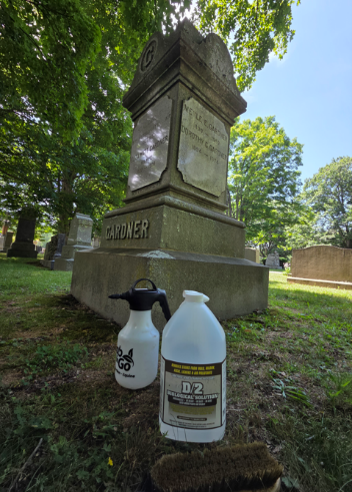
The beauty of D/2 Biological Solution is that it works as simple as wetting the stone with water, spraying it thoroughly with D/2, and walking away. D/2 works continuously on biological growth, helping preserve the stone over time, though more than one application may be needed. Use this spray-and-leave method for especially fragile stones, such as slate, sandstone, and old marble. Hardier stones—marble, schist, and granite—may tolerate a more hands-on approach. First wet the stone, then gently lift large lichen with a plastic putty knife. Spray with D/2 and let it sit for 15 minutes. Moisten with water, then use a soft-bristle brush to gently scrub the surface in circular motions. Rinse again to remove the lichen slurry. Finish with a final D/2 spray and walk away; time and the solution will handle the remaining layer.


Comments